
📅 Updated · July 2026
If you’re tired of being tired—and tired of sleep tips that feel like fluff—there’s one approach experts keep coming back to: Cognitive Behavioral Therapy for Insomnia (CBT-I). It’s not hypnosis. It’s not a meditation app. And it’s not another round of “have you tried chamomile tea?”
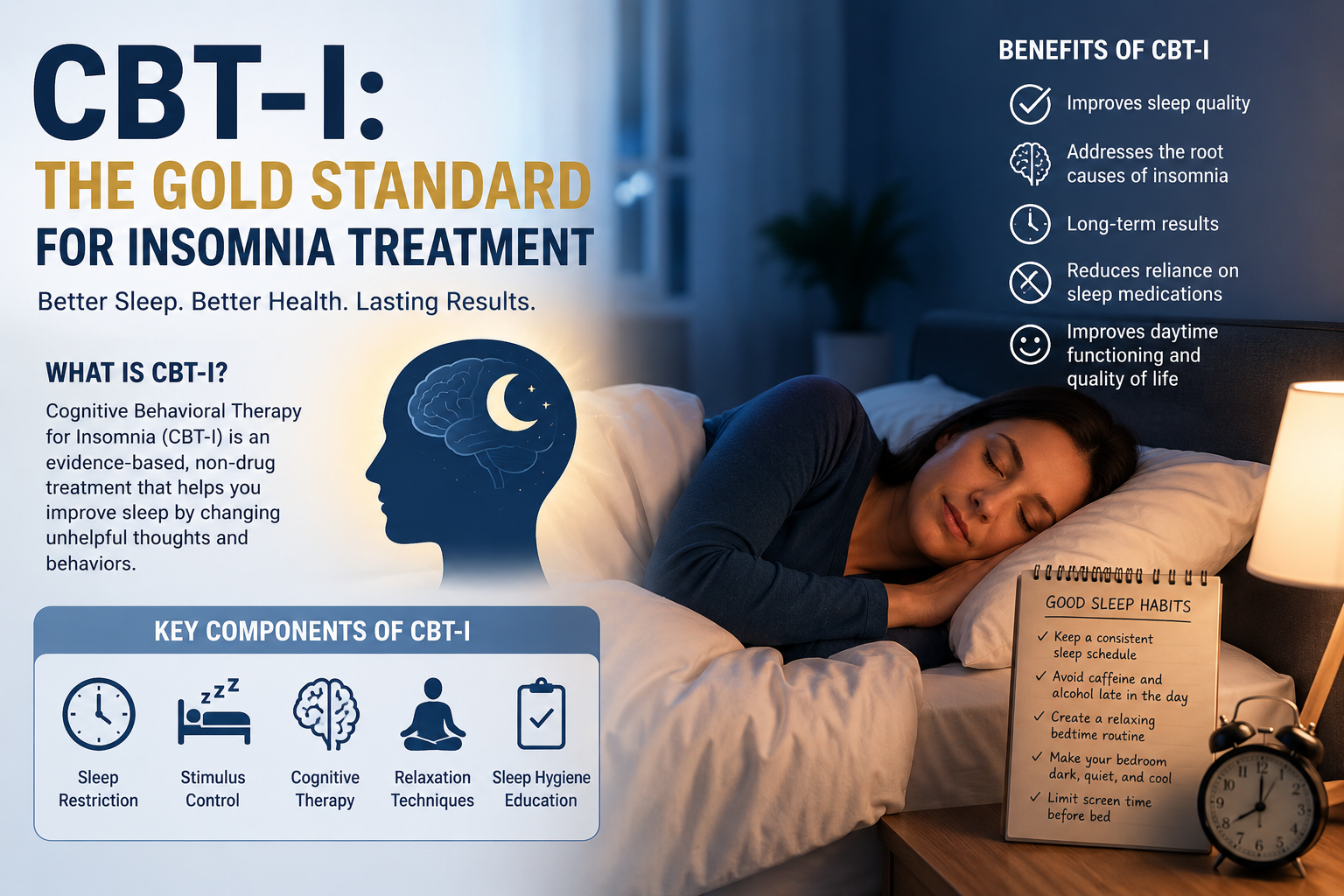
CBT-I is a structured, short-term therapy that helps you retrain your brain and body to fall asleep, stay asleep, and stop fearing your own bedtime. It’s widely considered the gold standard for treating insomnia. In fact, it works for more than 85% of people who try it, with durable benefits that last long after treatment ends.

What Is CBT-I?
Cognitive Behavioral Therapy for Insomnia (CBT-I) is a type of short-term structured therapy that’s the go-to treatment for insomnia. You work with a licensed therapist to adjust your sleeping routine and address sleep-related behaviors and thinking patterns. The treatment is structured, goal-oriented, and typically completed within four to eight sessions.
Think of it like a short skill-based course—usually six to eight weeks—focused entirely on helping you sleep better. It starts with a comprehensive assessment and sleep history. Your provider will ask about your schedule, routines, environment, mental health, and when your sleep issues started. The goal is to understand what triggered the problem and what’s now keeping it in place.
CBT-I is effective for improving nighttime and daytime symptoms of chronic insomnia, like waking up overnight and daytime sleepiness. It’s also effective for people with insomnia and comorbid conditions, including depression, PTSD, chronic pain, and obstructive sleep apnea.
📊 The Evidence Research has found that 70 to 80 out of 100 people show significant improvement in their sleep when engaging in CBT-I. The effects are long-lasting, making it more beneficial than medications for insomnia, which are typically only meant for short-term use.
The Five Core Components of CBT-I
CBT-I involves several components that work together to improve sleep. Based on your intake assessment and current needs, the most appropriate components will be selected to help improve your overall sleep quality.
1. Stimulus Control
Stimulus control therapy means pairing sleep-related things—like your bed and darkness—with sleep, while avoiding things associated with being awake—like screen time or reading—in your bedroom.
Key recommendations include:
- Lying down to sleep only when you’re sleepy
- Avoiding using your bed for activities other than sleep or sex
- Getting out of bed if you can’t fall asleep within 15 to 20 minutes
- Getting up at the same time every day, regardless of how much you slept
- Avoiding napping throughout the day
When you spend a lot of time in bed awake and frustrated, your body may start to link the bed with being awake and frustrated instead of being a place to sleep. Persistent insomnia develops as a result of this negative association. Stimulus control helps reverse this pattern.
2. Sleep Restriction (Consolidation)
Sleep restriction therapy (SRT) addresses the tendency for people with insomnia to make up for “lost” sleep by increasing their time in bed—going to bed earlier, sleeping in later, or napping. SRT tackles the mismatch between your sleep ability (how much you actually sleep) and your sleep opportunity (how much time you spend in bed).
You’ll temporarily limit the time you spend in bed to build a stronger sleep drive. Then, you’ll gradually increase your time in bed as sleep becomes more consistent. This improves sleep depth and efficiency. While you may feel slightly more tired at first, this should be temporary.
3. Sleep Education (Psychoeducation)
Your therapist will review common beliefs about sleep that aren’t necessarily true and lead to further issues. You’ll learn:
- How sleep pressure and your body’s internal clock work together
- Why certain habits and behaviors interfere with sleep
- The purpose behind treatment recommendations
You’ll also learn relaxation and wind-down strategies that help prepare your body for sleep and lower your physical and mental arousal.
4. Cognitive Therapy (Cognitive Restructuring)
Your therapist will help you change unhelpful thoughts and worries about sleep. For example, you may get anxious and anticipate not being able to fall asleep, or you might believe that your new sleep routine won’t work. They’ll help you focus on changing your responses to thoughts rather than forcing sleep.
Common unhelpful thought patterns include:
- Assuming you know what will happen in the future: “I know I’m going to have a terrible night’s sleep.”
- Making things bigger than they really are: “If I don’t get 8 hours, I’ll be a disaster tomorrow.”
- “All or nothing” black-and-white thinking: “If I don’t sleep perfectly, the whole night is ruined.”
- Imagining the worst-case scenario: “I’ll never get better. This is hopeless.”
💡 Practical Tip “To get a jumpstart on the process, write out negative thoughts and worries about insomnia on paper before getting in bed. Then, while you’re trying to fall asleep, focus on happy memories to neutralize negative thoughts.” — Dr. Waguih IsHak, Cedars-Sinai psychiatrist
5. Relaxation Techniques
These include deep breathing, progressive muscle relaxation (tensing and relaxing your muscles one body part at a time), and guided imagery (visualizing positive images and scenarios) to help you drift off to sleep.

Why CBT-I Comes Before Medication
CBT-I is the first-line treatment for chronic insomnia, recommended by major sleep and medical organizations. Why? Because it works, and the results tend to last.
Sleep medications might help short term, but they often come with side effects and don’t address the root issue. When you stop taking them, the sleep problem often returns. CBT-I, by contrast, teaches your body and brain how to sleep again, naturally. It’s noninvasive, research-backed, and often leads to lasting change without the rebound effect you might see with sleep medications.
A 2026 American Academy of Sleep Medicine (AASM) clinical practice guideline reinforces CBT-I’s position as the preferred first-line treatment. The guideline recommends CBT-I plus medication rather than medication alone in adults with chronic insomnia. However, it also suggests against routinely using combination therapy over CBT-I alone, noting that CBT-I by itself produces durable improvements without the risks associated with pharmacotherapy.
As lead author Daniel J. Buysse, MD, noted, “CBT-I by itself is the most efficacious first-line treatment for insomnia.”
For those exploring medical solutions, you can buy genuine medications online from trusted sources. However, CBT-I remains the preferred non-pharmacological approach.
⭐ Trusted Pharmacy
🚚 Fast Shipping
💊 Ambien (Zolpidem)
10mg
🌙 For sleep initiation · FDA-approved · Genuine medication
180 Pills
🔒 Encrypted payment
📦 Discreet shipping
⚕️ Prescription required. Always consult your doctor before use.
🛡️ FDA-approved · Licensed pharmacy
The Broader Benefits: Mental Health and Beyond
CBT-I doesn’t just improve sleep—it can have profound effects on overall mental health. A systematic review and meta-analysis published in 2024 examined the effects of CBT-I for prevention or early intervention of psychiatric disorders. The findings were striking:
- CBT-I was effective in reducing depressive symptoms with a significant effect size
- CBT-I may prevent incident and recurrent depression as an early intervention
- Data showed a direction in CBT-I reducing suicidal ideation via sleep system regularization
Insomnia is well-known to be both a risk factor and a prodrome for psychiatric disorders, including mood, anxiety, and psychotic disorders, as well as for suicide risk. Targeting insomnia with CBT-I may constitute a preventive strategy or an early intervention against the development or recurrence of psychiatric disorders.
In addition to helping with insomnia symptoms, CBT-I can help reduce symptoms of depression and anxiety. It may have benefits for other medical and psychiatric issues. People who do this therapy tend to have improvement in daytime functioning and quality of life, as well.

Who CBT-I Helps
CBT-I isn’t just for people with classic, standalone insomnia. Research shows it’s also effective for those navigating sleep issues alongside other conditions, including:
- Chronic pain: You may not be able to change the pain, but you can shift the habits and thoughts around sleep that have formed because of the pain.
- Cancer: In patients undergoing cancer treatment, CBT-I can improve restfulness and quality of life in a way that’s safe and gentle.
- Anxiety or depression: Addressing the sleep piece can give people a stronger foundation for emotional resilience.
- Post-traumatic stress disorder (PTSD): When paired with trauma-informed care, CBT-I can still be highly effective.
- Menopause: Hormonal changes during perimenopause and menopause often disrupt sleep patterns, and CBT-I can help women navigate those shifts.
Even better, CBT-I works in a variety of formats: in person, over telehealth, or through structured self-guided programs. Digital CBT-I applications have shown effectiveness in clinical trials, making this gold-standard treatment more accessible than ever.
For those who need medication support alongside therapy, Ambien 10mg is one option that can be discussed with a healthcare provider, but it should not replace the foundational work of CBT-I.
What to Expect During CBT-I
If you’re considering CBT-I, here’s what the process typically looks like:
- Duration: Most people complete CBT-I within four to eight sessions, with each session lasting 30 to 60 minutes.
- Frequency: Sessions are typically weekly or every other week.
- Sleep diary: You’ll keep a simple sleep diary and follow a personalized sleep schedule based on your actual sleep patterns.
- Timeline for improvement: Most people see an improvement in their insomnia symptoms within six to eight weeks of starting CBT-I.
It’s important to commit to your treatment plan and try to avoid exceptions to your schedule. Things you can do to help maintain consistency include setting an alarm for wakeup, telling your bed partner about your required bed and wake times, scheduling morning activities with others, and staying active in the hours leading up to your prescribed bedtime.

Challenges and Considerations
CBT-I takes work. You’ll likely have to make several changes to your routines and habits. This can be difficult. You may feel slightly more upset during therapy or get frustrated by the process. Your therapist can help you work through these feelings. You may also be more tired at first due to sleep restriction therapy, but this should be temporary.
One of the main challenges is finding a qualified CBT-I provider. The number of therapy places is still insufficient. However, it has been shown that CBT-I is also effective in shortened formats, digitally, or when carried out by other professional groups.
If you can’t access in-person therapy, digital CBT-I applications can also help—but work with your physician to choose one, as the app industry is unregulated.
For those who need medication support, Adderall 30mg is sometimes prescribed for daytime sleepiness, but it’s important to address the root sleep issues first.
Final Thoughts: Why CBT-I Is the Gold Standard
You may have tried to change your sleep habits in the past with no luck. So, you may be skeptical about how CBT-I can help with your insomnia. But hundreds of studies show that CBT-I works. Try to trust the process. Your behavioral sleep medicine specialist will be there to guide you through all the steps.
CBT-I is a proven, accessible treatment that helps your brain and body remember how to sleep, without relying on pills or gadgets. It’s short-term, structured, and just might be the most effective sleep strategy you’ve never tried.
Key takeaways:
- ✅ CBT-I is the first-line treatment for chronic insomnia, recommended by the AASM and other leading organizations
- ✅ It addresses the root causes of insomnia, not just symptoms
- ✅ Results are durable—most people continue to benefit after treatment ends
- ✅ CBT-I can prevent depression and improve overall mental health
- ✅ It works without medication, avoiding the risks of side effects and dependence
For those who need additional support or are exploring medical options, BuyYourStuff.us offers a range of medications for various conditions. Always consult with a healthcare professional before starting any new treatment.
📚 Related articles
🔗 Need help with insomnia or sleep issues?
🛒 Explore Our Products
View our complete range of genuine medications
